

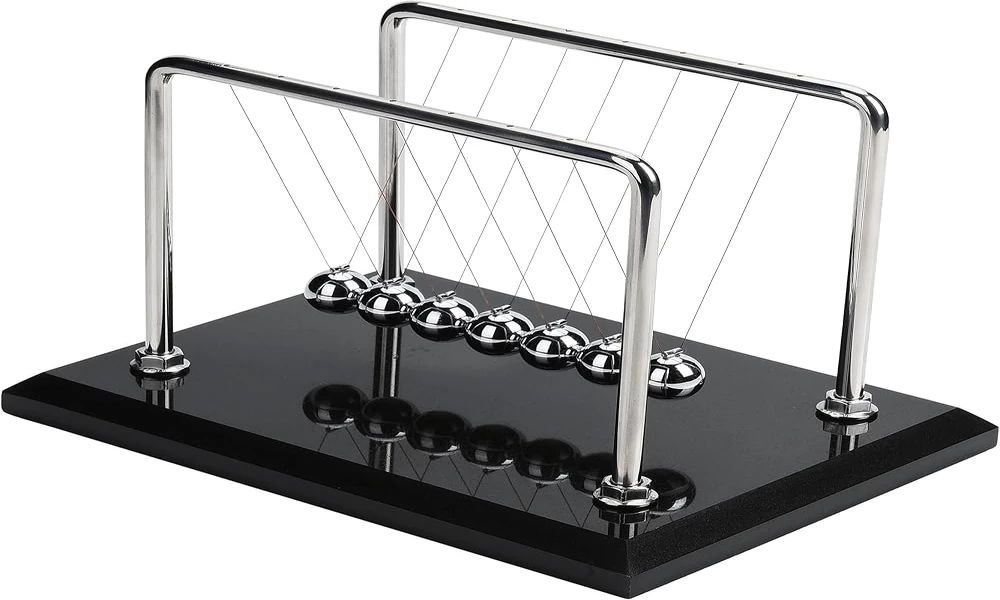
The Newton’s Cradle simulator by Active Kinetic 1 is a ready-to-use digital teaching aid designed to help educators and homeschooling parents explain core physics laws effortlessly. With one-click binary presets, instructors can demonstrate how dropping different numbers of balls creates predictable, symmetrical reactions across the cradle. The intuitive display lets teachers highlight momentum, kinetic energy, or both at once, making it easy to adapt a single visual demonstration for learners of varying abilities.
The Newton’s cradle is more than a decorative desktop physics toy: it is a convenient starting point for teaching scientific enquiry and critical thinking. The apparatus responds to changes in the way its suspended metal balls are released, allowing students to design experiments, make predictions and check whether the results support their ideas. Its familiar motion makes the activity approachable, but the explanations behind that motion can become surprisingly sophisticated.
A teacher might begin by asking what happens when one ball is released from a particular height. Students can then predict what will change if two balls are released, if the starting angle is increased or if the cradle is slightly misaligned. Each investigation encourages learners to identify an independent variable, observe a dependent variable and hold other conditions as constant as possible. Repeating trials helps distinguish a reliable pattern from an accidental result.
The Newton’s cradle simulator tool also teaches an important feature of scientific reasoning: a convincing explanation must account for more than appearances. It is tempting to say that motion simply passes from one ball to the next, but a fuller model must include momentum conservation, energy conservation, contact forces and the imperfect elasticity of real materials. Students can consider alternative explanations and evaluate which ones make the best predictions.
For older learners, slow-motion video, measurements of swing height and tables of observations can turn the demonstration into a quantitative investigation. They may compare ideal collision calculations with the behaviour of the actual device and identify experimental limitations. Learners also practise communicating uncertainty, recognising that small differences in timing or alignment may influence the observations. By encouraging questions, controlled testing and evidence-based conclusions, the Newton’s cradle helps develop transferable scientific skills that matter well beyond the study of mechanics.
Built with classroom pacing in mind, the Newton’s Cradle simulator includes pause and slow-motion features alongside realistic decay and paradox modes. Educators can show students why real pendulums gradually lose energy to friction, sound, and heat, and use the visual Paradox mode to spark lively discussions about why certain collision outcomes are physically impossible. Best of all, the simulator includes a simple embed code so teachers can place this interactive physics lab directly onto their own class websites or learning blogs.
Newton’s Cradle Simulator
Compare classical mechanical sphere impacts with parallel-face Active Magnetic Cradle (AMC) dipole carriages.
|
Impacts: 0 | Energy Retained: 100.0%
