

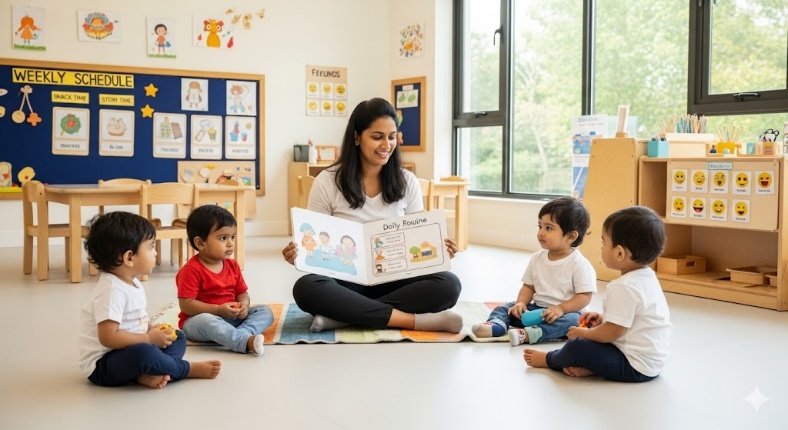
I still remember the morning I dropped my son off at playgroup for the first time. He was clutching his favorite worn-out teddy bear, and I was clutching the gate, my heart doing somersaults. As I walked away, the silence in the car felt heavy. Every parent in Mumbai eventually faces this emotional tug-of-war: “Am I pushing them out of the nest too soon? Or am I holding them back from learning to fly?”
If you are raising a family in our vibrant suburb, this decision is even more nuanced. You want a Preschool in Kharghar that isn’t just a “holding center” for a few hours. You want a second home—a sanctuary that balances the hustle of city life with the warmth of traditional values.
Finding the right partner for your child’s early years is a journey. Today, we are cutting through the noise to answer the two biggest questions keeping parents awake at night: When should they start, and How do you choose the right place?
The Big Decision: At What Age Should a Child Join Playgroup?
Let’s tackle the elephant in the room. There is a lot of conflicting advice out there. Your neighbor might say three is best, while your pediatrician suggests two. So, what does the research say?
When we look at at what age should a child join playgroup, the “sweet spot” for most children is between 1.8 to 2.5 years.
Why this specific window?
- The Social Shift: Around age two, toddlers transition from “parallel play” (playing next to others) to genuine curiosity about others. They start needing social interaction that adults simply cannot replicate.
- Language Explosion: Between 18 and 30 months, vocabulary growth is exponential. Being in a language-rich environment with peers accelerates this process significantly.
However, age is just a number. At Basil Woods Kharghar we often see “ready” 18-month-olds and “not-quite-ready” 3-year-olds. It’s less about the birth date and more about developmental readiness.
Is Your Child Ready? The “Green Light” Checklist
Before you fill out admission forms, look for these signs. If you can tick off most of them, your little one is likely ready to soar:
- Physical Independence: Can they walk steadily without support? Can they handle finger foods or hold a sippy cup?
- Communication: This doesn’t mean speaking full sentences. Can they express basic needs—like hunger or needing the toilet—even if it’s just through gestures or single words?
- The “Bye-Bye” Test: Can they handle being away from you for 2-3 hours? (Note: Some tears are normal; sheer panic is not).
- Curiosity: Do they perk up when they see other children at the park? Do they try to mimic what older kids are doing?
If you are still unsure, our detailed guide on at what age should a child join playgroup dives deeper into these behavioral cues.
Best Practices: What to Look for in a Kharghar Preschool
Kharghar is a unique pocket of Mumbai—a blend of old-world charm and modern aspirations. The parents here are discerning. You don’t just want an academic drill; you want a holistic environment. Here are the best practices to keep in mind when scouting for a Preschool in Kharghar.
1. The “Culture + Modern” Balance
In a globalized world, roots matter. The best schools today don’t force you to choose between modern Montessori methods and your cultural heritage. Look for a curriculum that blends IQ (Intelligence Quotient) with SQ (Spiritual Quotient). At Basil Woods, our “Culture Connect” program ensures children learn about aerodynamics in the morning and the value of gratitude from Indian epics in the afternoon.
2. Space to Move (A Luxury in Mumbai)
Toddlers learn through movement. If a preschool feels cramped or is stuck inside a small apartment, walk away. Gross motor skills—running, climbing, balancing—are critical for brain development. We take pride in offering one of the most spacious, child-friendly campuses in Sindhi Society, giving your child the room they need to grow.
3. Safety & Hygiene Protocols
This is non-negotiable. Does the school have CCTV? Are the furniture corners rounded? Is the staff trained in basic first aid? A premium Preschool in Kharghar puts safety above everything else.
Why “Preschool in Kharghar” Means Basil Woods
We understand that you are trusting us with your heart. That is why Basil Woods Kharghar is designed to be an extension of your family.
From our Pre-Toddler programs (15 months+) that focus on gentle sensory integration to our structured Playgroup (2-3 years), every corner of our campus is built to nurture the PQ + IQ + EQ + SQ (Physical, Intellectual, Emotional, Spiritual) of your child. We don’t just teach them to count; we teach them what counts.
Conclusion: Trust Your Instincts
The early years are fleeting. They are less about rigid milestones and more about joy, curiosity, and feeling safe. Whether your child is 18 months or 2.5 years old, the right environment will meet them exactly where they are.
Don’t rush the process. Visit the campus, meet the teachers, and trust your gut feeling.
Still wondering if your little one is ready? Visit Basil Woods Kharghar today to see our happy learners in action and find the perfect fit for your family.
FAQs
1. What is the minimum age for Preschool in Kharghar admission? Most programs, including ours at Basil Woods, accept children as young as 15-18 months for Pre-Toddler programs, while formal Playgroup typically starts at 2 years.
2. How does Basil Woods help toddlers settle in? We believe in a “gradual separation” policy. Parents are encouraged to stay close during the first few days, slowly increasing the distance as the child bonds with their teacher and new friends.
3. What is the difference between Pre-Toddler and Playgroup? Pre-Toddler is unstructured, focusing on sensory play and comfort. Playgroup introduces a gentle routine (circle time, rhymes) to prepare them for future schooling.
Basil Woods Juniors in Kharghar Mumbai- First time in India a preschool with culture connect
This video is relevant because it provides a virtual tour of the Basil Woods Kharghar campus and visualizes the “Culture Connect” methodology discussed in the post.
